
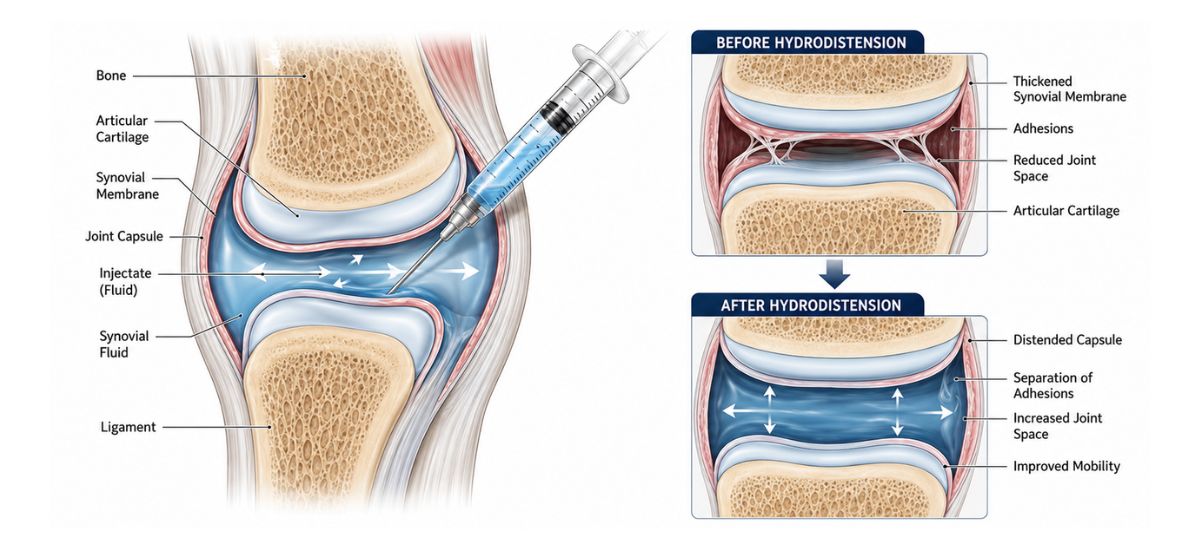
Hydrodistension is a minimally invasive procedure used to help improve movement in a stiff or restricted joint.
The procedure involves placing sterile fluid into the joint space to gently stretch the joint capsule. The joint capsule is the tissue that surrounds and supports the joint. When it becomes tight or restricted, movement can become painful and limited.
At DeNova Health, hydrodistension may be considered when joint stiffness, pain, or reduced range of motion is affecting daily activity and a targeted procedure may be appropriate.
What This Procedure Does
Hydrodistension is intended to help improve joint mobility by reducing capsular restriction within the joint. By creating more space within the capsule, the procedure may help decrease stiffness, improve range of motion, and support participation in stretching, strengthening, or rehabilitation exercises.
Hydrodistension is not intended for all types of joint pain. Treatment recommendations are based on whether joint capsule restriction appears to be contributing to the condition.
When Hydrodistension May Be Considered
Hydrodistension may be discussed when joint stiffness is limiting movement and conservative care has not provided enough improvement.
It may be considered when:
- Joint movement is restricted: The joint feels tight, stiff, or difficult to move through its normal range.
- Pain limits daily activity: Reaching, lifting, walking, stairs, work, or exercise may be affected depending on the joint involved.
- The joint capsule may be tight: Symptoms suggest the tissue around the joint is restricting movement.
- Therapy needs support: The procedure may help improve movement enough to make stretching or rehabilitation more effective.
- A targeted approach is appropriate: The affected joint can be assessed and matched to a clear treatment plan.
What to Expect at Your Visit
Your visit starts with an assessment of your symptoms, movement, and medical history. If hydrodistension is appropriate, the clinician will explain the procedure and how it fits into your care plan.
The treatment area is cleaned and prepared. Fluid is then placed into the joint space to help expand the joint capsule. You may feel pressure, fullness, or temporary discomfort during the procedure.
Aftercare and Recovery
Aftercare may include:
- Gentle movement: You may be encouraged to move the joint within the limits provided by your clinician.
- Temporary soreness: The joint may feel tender, full, or irritated for a short time.
- Activity guidance: You may need to avoid heavy loading or intense activity for a short period.
- Rehabilitation support: Stretching, strengthening, or physical therapy may be recommended to help maintain improved movement.
- Follow-up review: A follow-up may be suggested to assess range of motion, pain, and function.
Possible Side Effects and Limitations
Possible side effects may include:
- Temporary joint soreness: The treated joint may feel achy or irritated after the procedure.
- Pressure or fullness: The joint may feel temporarily full because fluid has been placed into the capsule.
- Bruising or swelling: Mild bruising, swelling, or tenderness may occur around the injection site.
- Short-term stiffness: The joint may feel stiff or sensitive before symptoms begin to settle.
- Variable results: Some patients improve, while others may need additional therapy, reassessment, or another treatment option.
Hydrodistension is not a guaranteed fix. It may be helpful when joint capsule restriction is part of the problem, but results depend on the diagnosis, severity of stiffness, and the follow-up care plan.
Book a Hydrodistension Consultation
If joint stiffness or reduced movement is making daily activity harder, DeNova Health can assess whether hydrodistension may be an appropriate option.
Book an appointment to review your symptoms, discuss your treatment options, and determine whether this procedure fits your care plan.