
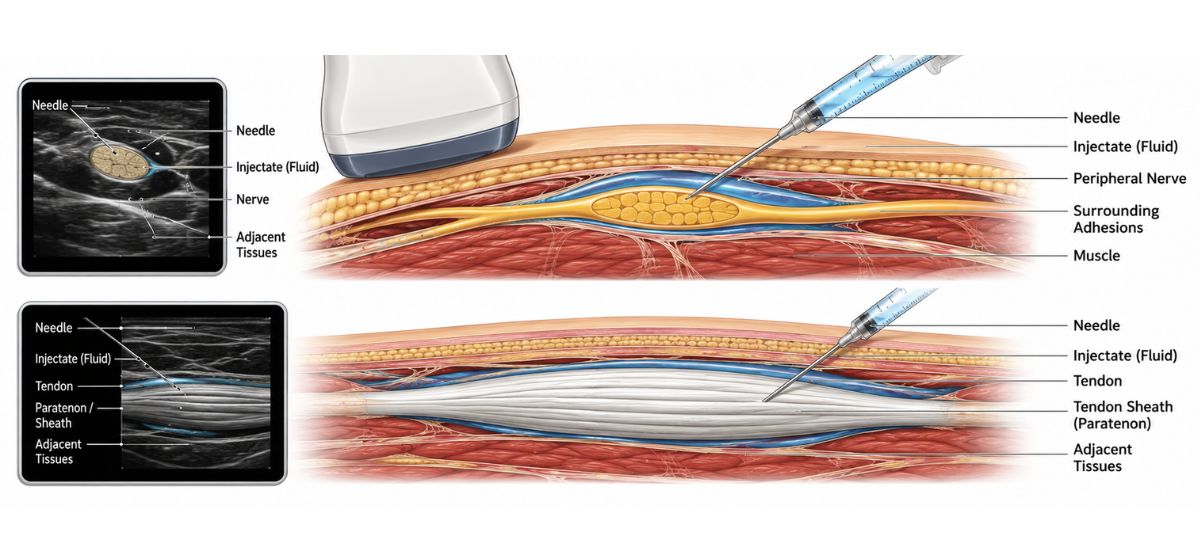
Hydrodissection is a minimally invasive procedure that uses fluid to gently separate irritated nerves or tendons from nearby tissue.
This procedure is usually performed with ultrasound guidance, which allows the clinician to see the area in real time and guide the needle more accurately. The goal is to create space around a nerve or tendon that may be compressed, restricted, irritated, or not gliding properly.
At DeNova Health, hydrodissection may be considered when symptoms suggest that a nerve or tendon is being affected by surrounding tissue, pressure, or movement restriction.
What This Procedure Does
For nerves, hydrodissection may be used when a nerve appears trapped or irritated along its pathway. For tendons, it may be considered when movement is limited by surrounding tissue restriction or adhesions.
This is not a general treatment for all nerve or tendon pain. It is used when the assessment suggests that a specific structure can be safely targeted.
When Hydrodissection May Be Considered
Hydrodissection may be discussed when symptoms are linked to nerve irritation, tendon restriction, or reduced tissue movement.
It may be considered when:
- Nerve symptoms are present: Tingling, burning, numbness, or shooting pain may suggest nerve irritation.
- A nerve may be compressed: Symptoms may be related to pressure around a peripheral nerve.
- A tendon is not gliding well: Pain or stiffness may be connected to restricted tendon movement.
- Conservative care has not been enough: Therapy, bracing, footwear changes, activity modification, or other treatments have not fully settled the issue.
- Ultrasound can identify a target area: The procedure works best when the affected nerve or tendon can be clearly located.
What to Expect at Your Visit
Your visit starts with an assessment of your symptoms, movement, and medical history. If hydrodissection is appropriate, ultrasound is used to locate the affected nerve or tendon and guide the procedure.
The treatment area is cleaned and prepared, then fluid is placed around the targeted nerve or tendon to help create separation from nearby tissue. You may feel pressure, fullness, or temporary discomfort during the procedure.
Aftercare and Recovery
Aftercare may include:
- Temporary activity changes: You may need to avoid heavy loading, repetitive movement, or intense exercise for a short time.
- Mild soreness: The treated area may feel tender, full, or irritated after the procedure.
- Movement guidance: Gentle movement may be recommended to help the nerve or tendon glide properly.
- Ongoing support: Physical therapy, bracing, footwear changes, or activity modification may still be part of your plan.
- Follow-up review: A follow-up may be recommended to assess how symptoms respond.
Possible Side Effects and Limitations
Possible side effects may include:
- Temporary soreness: The area may feel tender or irritated for a short time.
- Bruising or swelling: Mild bruising, swelling, or pressure may occur around the injection site.
- Temporary symptom flare-up: Nerve or tendon symptoms may feel more noticeable before settling.
- Incomplete relief: Some patients may need additional care, therapy, repeat assessment, or another treatment option.
- Condition-specific results: Outcomes depend on the location, severity, and cause of the nerve or tendon irritation.
Hydrodissection is not a guaranteed fix. It may be helpful when a nerve or tendon is restricted or irritated by surrounding tissue, but the best results depend on the diagnosis and the overall care plan.
Book a Hydrodissection Consultation
If nerve pain, tingling, numbness, tendon pain, or restricted movement is affecting your daily activity, DeNova Health can assess whether hydrodissection may be an appropriate option.
Book an appointment to review your symptoms, discuss your treatment options, and determine whether this procedure fits your care plan.