
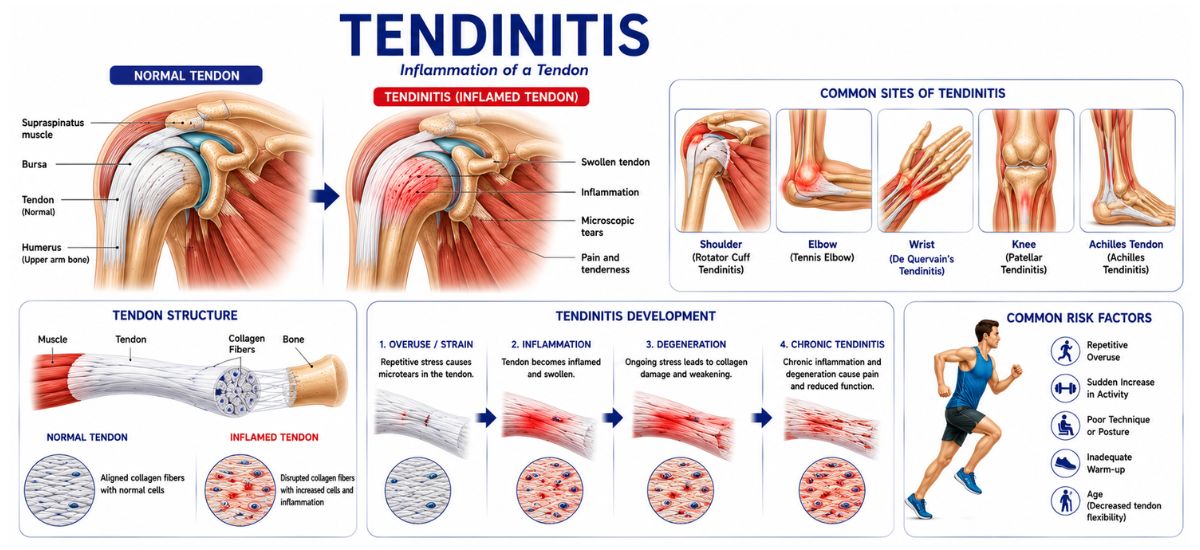
Tendinitis happens when a tendon becomes irritated, inflamed, or painful. Tendons are strong bands of tissue that connect muscles to bones and help your joints move.
This condition can affect many areas of the body, including the foot, ankle, knee, shoulder, elbow, wrist, and hand. It may come on after a sudden increase in activity, repeated movement, poor mechanics, or an injury.
DeNova Health assesses tendon pain, movement, strength, and daily function to help patients find care options that reduce irritation, improve mobility, and support a safer return to activity.
What You Might Be Feeling
Tendinitis can feel like a deep ache, sharp pain, or tenderness near a joint. Symptoms may be mild at first and become more noticeable with repeated movement.
Common signs may include:
- Pain near a tendon: Discomfort may be felt close to a joint, especially with movement or activity.
- Tenderness to touch: The area may feel sore when pressed or irritated by pressure.
- Swelling or warmth: The tendon area may look puffy or feel inflamed after use.
- Stiffness with movement: The joint may feel tight, limited, or harder to move comfortably.
- Weakness during activity: Lifting, gripping, walking, stairs, or exercise may feel more difficult.
Why It May Be Happening
Tendinitis is commonly connected to repeated strain, sudden overload, or irritation around the tendon. It can also be affected by strength, flexibility, posture, footwear, or joint mechanics.
- Repetitive movement: Work tasks, sports, exercise, or daily habits can overload the tendon over time.
- Sudden activity changes: Increasing intensity, distance, weight, or frequency too quickly can irritate the tendon.
- Poor movement mechanics: The way a joint moves can place extra stress on the tendon.
- Age-related tendon changes: Tendons may become less flexible and more prone to irritation over time.
- Previous injury: A past sprain, strain, or joint injury can make the tendon work harder than it should.
How DeNova Health Approaches Tendinitis Care
Tendinitis care starts by looking at where the pain is located, what movements trigger it, and how the symptoms are affecting your daily routine.
Depending on the area involved and the severity of symptoms, care may include:
- Assessment and movement review: A clinical assessment can help identify which tendon is irritated and what may be contributing to the strain.
- Custom orthotics, shoes and braces: Supportive devices may help reduce pressure, improve alignment, and protect irritated tendons in the foot, ankle, or lower body.
- Physical therapy and exercise training: Guided stretching and strengthening can help improve tendon tolerance, mobility, and function.
- Therapy-based treatments: Shockwave therapy, laser therapy, therapeutic ultrasound, or TENS may be considered when appropriate.
- Injection therapies: Options such as corticosteroids, platelet rich plasma (PRP), prolotherapy and/or biologic compatible hyaluronic acid may be discussed. Surgical options may be discussed when appropriate.
Surgical options may be discussed when appropriate.
When It's Worth Booking an Appointment
You should consider booking an assessment if tendon pain is affecting work, walking, exercise, sleep, or daily movement.
- Pain keeps coming back: Symptoms improve with rest but return when you use the area again.
- Movement feels limited: The joint feels stiff, weak, or difficult to move comfortably.
- Daily tasks are harder: Walking, lifting, gripping, stairs, sports, or work duties are being affected.
- Swelling or tenderness continues: The tendon area stays sore, puffy, or sensitive to touch.
- You are changing how you move: You start limping, avoiding certain motions, or compensating with another part of the body.
Get Assessed at DeNova Health
If tendon pain is making movement uncomfortable or stopping you from doing regular activities, DeNova Health can help assess what may be contributing to the irritation.
Book an appointment at DeNova Health to review your symptoms and discuss a care plan focused on pain relief, better movement, and a safe return to activity.