
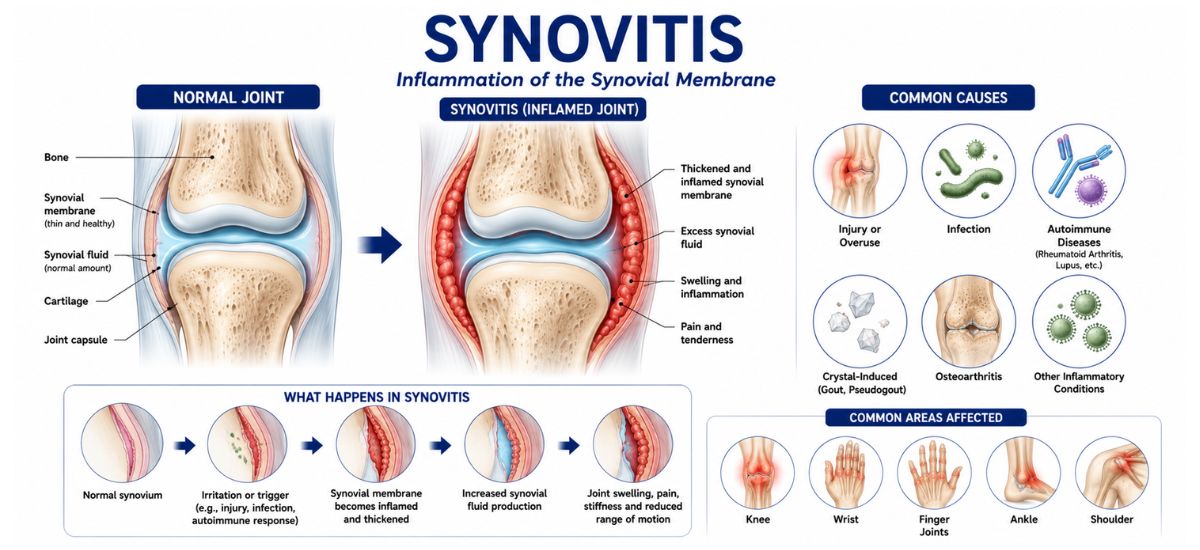
Synovitis happens when the lining inside a joint becomes inflamed. This lining is called the synovial membrane, and it helps the joint move smoothly.
When the synovial membrane becomes irritated, the joint may feel swollen, painful, stiff, or harder to move. Some people notice symptoms after an injury or repetitive strain, while others may have synovitis connected to arthritis or another inflammatory condition.
DeNova Health looks at how the joint is moving, where the swelling or pain is located, and what may be placing stress on the area. From there, care can be focused on reducing irritation, improving movement, and helping you return to daily activity more comfortably.
Signs the Joint Lining May Be Irritated
Synovitis can affect one joint or several joints, depending on the cause. The symptoms may be mild at first or become more noticeable during movement.
Common signs may include:
- Joint swelling: The joint may look puffy or feel full because of inflammation or extra fluid.
- Pain with movement: Bending, walking, gripping, or putting weight through the joint may feel uncomfortable.
- Stiffness after rest: The joint may feel tight after sitting, sleeping, or being still for a while.
- Warmth or tenderness: The area may feel sensitive, irritated, or warm to the touch.
- Reduced function: Normal movement may feel limited, weak, or harder to control.
What Can Lead to Synovitis?
Synovitis can happen for different reasons. In some cases, it follows an injury or repeated joint stress. In other cases, it may be part of a larger inflammatory condition.
- Arthritis-related inflammation: Conditions such as rheumatoid arthritis, psoriatic arthritis, gout, or osteoarthritis may involve synovial irritation.
- Joint injury: A sprain, twist, impact, or trauma can irritate the joint lining.
- Repeated strain: Work tasks, sports, exercise, or daily movement patterns can place ongoing stress on a joint.
- Crystal-related inflammation: Conditions such as gout or pseudogout can cause sudden joint inflammation.
- Infection or illness: A hot, very swollen, severely painful joint should be assessed promptly, especially if symptoms come on quickly.
How DeNova Health Approaches Synovitis Care
Synovitis care starts with identifying which joint is irritated and whether the symptoms appear mechanical, inflammatory, injury-related, or connected to another health concern.
Depending on the joint involved and the severity of symptoms, care may include:
- Joint and movement assessment: A clinical review can help identify how the joint is moving and what may be aggravating it.
- Custom orthotics, shoes and braces: Support may help reduce pressure when synovitis affects the foot, ankle, knee, or lower body.
- Physical therapy and exercise training: Guided movement may help improve strength, flexibility, balance, and joint control.
- Therapy-based treatments: Laser therapy, therapeutic ultrasound, TENS, or shockwave therapy may be considered when appropriate.
- Injection therapies: Options such as corticosteroids, hyaluronic acid and platelet rich plasma (PRP) with ultrasound guidance may be discussed. Surgical options may be discussed when appropriate.
Surgical options may be discussed when appropriate.
When It's Worth Booking an Appointment
A swollen or painful joint should not be ignored if it is affecting how you move, work, walk, exercise, or complete daily tasks.
- The joint stays swollen: Puffiness, fullness, or fluid around the joint does not settle.
- Movement is becoming limited: The joint feels stiff, restricted, or harder to bend and straighten.
- Pain is changing your routine: You are avoiding stairs, walking, lifting, gripping, or other normal activities.
- Symptoms keep flaring: The joint improves for a short time, then becomes painful or swollen again.
- The joint is hot, red, or severely painful: Sudden intense pain, fever, or major swelling should be checked urgently.
Get Assessed at DeNova Health
If joint swelling, stiffness, or pain is making movement harder, DeNova Health can assess the affected area and help determine what type of care may be appropriate.
Book an appointment at DeNova Health to review your symptoms and discuss a care plan focused on reducing irritation, improving movement, and supporting better daily function.